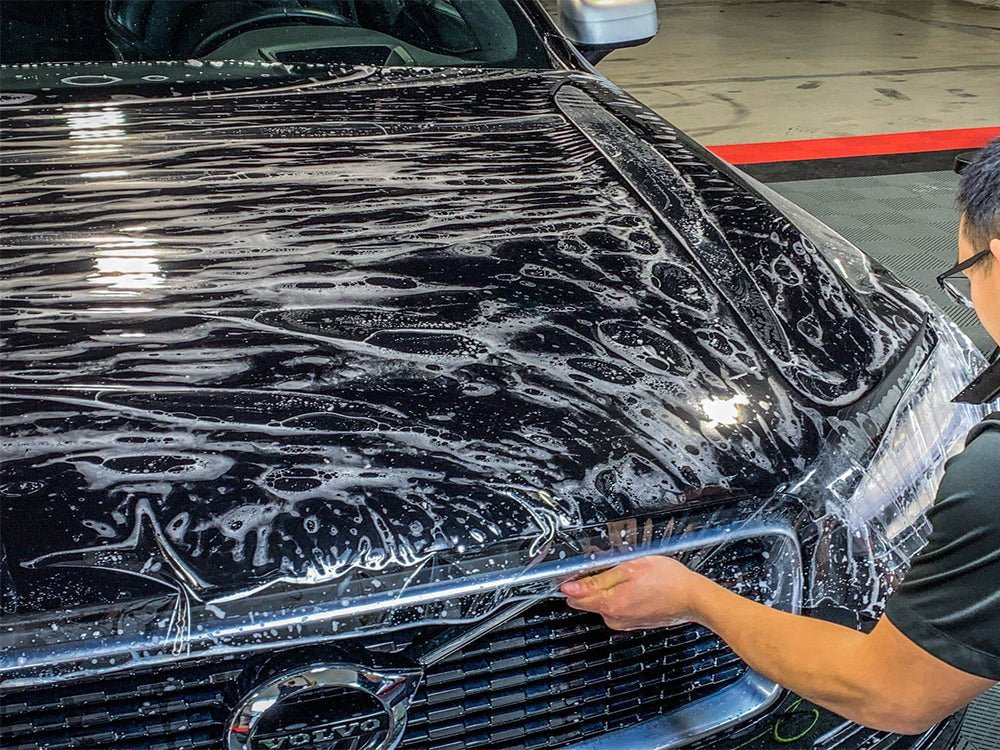

PPF is widely favored by car owners and the automotive detailing industry due to its excellent scratch resistance,stone chip protection,self-healing properties,and paint protection performance. However,PPF may develop yellowing over time with extended use.So,why does Paint Protection Film turn yellow? Does all PPF experience yellowing?In fact,PPF yellowing is closely related to multiple factors,including TPU substrate type,UV stabilization technology,surface coating,adhesive formulation,and usage environment.This article will analyze the main causes of PPF yellowing,the influencing factors,how to evaluate yellowing resistance,and how to choose a truly durable paint protection film,helping car owners and automotive detailing professionals better understand this important issue.
What Is PPF Yellowing?
PPF yellowing refers to the phenomenon where Paint Protection Film gradually changes from its original transparent and colorless appearance to a slightly yellow or noticeably yellow appearance during long-term use due to factors such as UV exposure,continuous high temperatures,and oxidative aging.Yellowing not only affects the transparency and appearance of PPF,but may also impact the original color presentation of the vehicle paint.

Why Does PPF Turn Yellow?
Yellowing Resistance of the TPU Material Itself
The main substrate of PPF is typically TPU. Different grades and formulations of TPU can have significant differences in UV resistance,oxidation resistance,and heat resistance.If the TPU raw material has a lower yellowing resistance rating,long-term exposure to sunlight,UV radiation,and high-temperature environments can accelerate oxidation and aging of the material,leading to gradual yellowing.Therefore,the quality and formulation of the TPU raw material are important factors affecting the long-term transparency of PPF.
Long-Term UV Exposure
When a vehicle is parked outdoors for extended periods,PPF is continuously exposed to solar ultraviolet radiation.UV rays can accelerate the aging of the TPU molecular structure and may cause color changes in the material.Especially in areas with high UV intensity and strong sunlight,the yellowing process usually occurs more quickly.

High Temperature Accelerates Aging
After a vehicle is exposed to sunlight for a long time in summer,the surface temperature of the vehicle body increases. If PPF is continuously exposed to high-temperature conditions,it can accelerate the oxidation process.Therefore,the yellowing resistance of PPF should not only be evaluated under normal temperature conditions,but also under high-temperature environments.
Adhesive Yellowing
The yellowing resistance of the adhesive itself can also affect the overall transparency of the film.If the adhesive has insufficient UV resistance and oxidation resistance,the adhesive layer may gradually turn yellow after long-term use,causing the entire PPF to appear yellowish or amber in color.

Insufficient Anti-Aging System in Raw Materials and Formulation
PPF typically incorporates functional additives such as UV absorbers,light stabilizers,and antioxidants to help slow down material aging.If the selection,addition ratio,or formulation system of these additives is not properly optimized,the yellowing resistance of PPF may decrease after long-term exposure to outdoor environments.So,even among TPU PPF products,the yellowing resistance lifespan can vary significantly between different products.
Surface Contaminants and Chemical Substances
In some cases,the “yellowing” perceived by vehicle owners may actually be caused by surface contamination or chemical residue. For example,bird droppings,tree sap,tar,and oil stains can remain attached to the PPF surface for a long time,which may cause yellow,brown,or localized discoloration.

Natural Aging of Materials Due to Long-Term PPF Use
PPF itself is a polymer material that is continuously exposed to external environmental conditions. Even when using high-quality TPU and adhesive materials,years of exposure to UV radiation,oxygen,heat,moisture,and environmental pollutants will gradually cause aging.Therefore,“yellowing resistance” does not mean that the PPF will never turn yellow. Instead,it indicates that the product can maintain good transparency and color stability within a certain service period.
Aliphatic TPU VS Aromatic TPU
| Comparison Item |
Aliphatic TPU |
Aromatic TPU |
| Common Isocyanates |
HDI,IPDI,H12MDI,etc. | MDI、TDIetc. |
| UV Resistance | ⭐⭐⭐⭐⭐ |
⭐⭐ |
| Yellowing Resistance | ⭐⭐⭐⭐⭐ |
⭐⭐ |
| Long-Term Transparency |
Strong ability to maintain transparency |
Long-term UV exposure may cause transparency to decline more easily |
| Weather Resistance |
Excellent,suitable for long-term outdoor use |
Relatively weaker |
| Color Stability |
Excellent |
Poorer |
| Mechanical Properties |
Excellent |
Excellent |
| Flexibility |
Depends on the specific product grade |
Depends on the specific product grade |
| Self-Healing Performance |
Can achieve excellent performance,but mainly depends on the specific formulation and Top Coat |
Can also have self-healing performance; it is not determined solely by “aromatic/aliphatic” structure |
| Raw Material Cost |
Usually higher |
Usually lower |
| PPF Positioning |
More commonly used in mid-to-high-end and premium PPF products |
More commonly found in economy and some mid-range products |
Can PPF Yellowing Be Repaired?
- Mild Yellowing: If the yellowing is caused by surface contamination,oxidation,or slight color changes due to long-term use,professional cleaning and maintenance may help improve the appearance. However,it may not be possible to completely restore the original appearance.
- Yellowing of the Material Itself: If the yellowing is caused by the TPU material,insufficient UV resistance,or long-term UV aging,it is generally considered material degradation. It cannot usually be restored to its original transparency through maintenance or care treatments.
- Adhesive Yellowing: If the yellowing mainly comes from adhesive aging,it also generally cannot be repaired through surface treatment,because the discoloration occurs within the internal structure of the film.

How to Prevent PPF Yellowing
- Choose High-Quality TPU Substrate:High-quality TPU offers better UV resistance,oxidation resistance,and weather resistance,which can effectively reduce the risk of yellowing during long-term use.
- Choose PPF with Good UV Resistance:Long-term exposure to sunlight can accelerate the aging of TPU and the adhesive layer. PPF with strong UV blocking performance can help delay the yellowing process.
- Avoid Prolonged Exposure to Direct Sunlight:Long-term direct sunlight exposure and high-temperature environments can accelerate material aging.When possible,it is recommended to park the vehicle in a garage,underground parking area,or shaded location.
- Clean the PPF Surface Regularly:Contaminants such as bird droppings,tree sap,insect residue,and oil stains may accelerate surface aging if they remain attached for a long time.Regular cleaning is recommended to prevent prolonged contamination.
- Use Suitable Maintenance Products:Regular use of professional care products designed for PPF can help maintain the film’s gloss and cleanliness.Avoid using strong acidic,strong alkaline,or chemical cleaners that may damage the film surface.
- Ensure Proper Installation and Maintenance:Before installation,the vehicle paint surface should be properly cleaned and free of oil stains and contaminants.Following correct installation procedures is essential,as installation quality also affects the long-term performance of PPF.
Conclusion
PPF yellowing is not an inevitable result during the use of paint protection film,but is determined by a combination of factors including material quality,production processes,UV protection capability,and usage environment.For vehicle owners seeking long-term protection performance,choosing PPF should not only focus on price and thickness,but also consider the product’s core performance.An excellent PPF should not only provide protection against daily scratches,stone impacts,and environmental contaminants,but more importantly,should be able to maintain its original transparency and appearance even after years of use.
FAQ
Does your PPF have self-healing function?
Yes,Carlike Car PPF features thermal self-healing performance. The self-healing coating on the film surface can be activated by heat,allowing minor surface scratches to gradually recover.For light scratches,the heat generated by sunlight can activate the self-healing effect. An appropriate external heat source can also be used to accelerate the healing process.It should be noted that the self-healing performance is mainly designed for minor surface scratches and fine abrasions. Deeper scratches,cuts,or damage that has penetrated through the surface layer generally cannot be completely restored through the self-healing process.
Does your adhesive leave residue after removal?
Carlike Car PPF uses removable pressure-sensitive adhesive. Under normal installation,usage,and removal conditions,the film can generally be removed without leaving noticeable adhesive residue on the vehicle paint surface.The actual removal performance may be affected by factors such as application time,condition of the vehicle paint surface,ambient temperature,and removal method.For better removal performance,it is recommended to perform installation and removal at a suitable ambient temperature and using the proper removal technique,thereby reducing the risk of adhesive residue.
What type of adhesive system do you use?
Carlike Car PPF uses removable pressure-sensitive adhesive,which provides good initial adhesion and stable bonding between the film and vehicle paint surface while also maintaining good removability. Under normal installation and usage conditions,the PPF can generally be removed with a low risk of adhesive residue,making subsequent replacement or reinstallation more convenient.
Do you offer economy, mid-range, and premium PPF grades?
Carlike offers three PPF product tiers: Economy,Mid-Range,and Premium,to meet the needs of customers with different market positioning,application requirements,and budgets. The different product series vary in terms of TPU substrate,optical performance,yellowing resistance,weather resistance,and overall service life,allowing customers to select the most suitable product tier based on their target market and end-customer requirements.

Carlike offers TPU PPF in a variety of thicknesses and surface finishes to meet different market and application requirements. Transparent TPU PPF is available in thicknesses of 6.5 mil,7.5 mil,8.5 mil,and 10 mil,with both Gloss and Matte finishes available.In addition,Carlike offers a wide range of Color PPF options,including Gloss,Matte,Carbon Fiber,Chameleon,Pearlescent,Metallic,and Liquid finishes,providing customers with more choices for appearance customization and product portfolio development.