
Table of content
Introduction of TPU
Scroll through Instagram, park at any super-charger, or walk the SEMA show floor and you will notice the same phrase on banner after banner: “Now available in TPU.”
Thermoplastic polyurethane color-change wraps—part fashion statement, part body armor—have left the niche “detailer” corner and entered the vocabulary of everyday buyers, fleet managers and even OEM product planners. In this 1,000-plus-word breakdown we will look at why, after fifteen years of PVC vinyl dominance, the industry is quietly coalescing around TPU as the next default film, how big the numbers really are, and which specific products you are most likely to see on your neighbor’s SUV next summer.

1. From Niche to Norm: The Macro Numbers
According to the most recent market synthesis published in December 2025, the global TPU automotive paint-protection film segment alone (transparent and color-printed combined) is expected to reach USD 1.18 billion in 2025, growing at a 5.2 % CAGR through 2033 .
Overlay that with the wider “automotive wrap film” category tracked by Technavio and you get a combined annual spend north of $2.4 billion, with TPU SKUs accounting for 42 % of volume in 2025 versus only 19 % in 2022 .
Translation: every second roll that leaves a factory today is already TPU; by 2028 analysts expect the ratio to surpass 70 %. The inflection point is not “coming”—it is happening.
2. PVC Fatigue: Why the Old Workhorse Lost the Plot
Poly-vinyl chloride films brought color wrapping to the masses because they were cheap (≈$600 material cost for a sedan) and available in every RAL or Pantone hue imaginable.
Yet after a decade on the road the weaknesses are impossible to ignore:
- Zero impact resistance – gravel that would bounce off a factory clear-coat will puncture 80-µm PVC.
- Plasticizer migration – the film becomes brittle, shrinks and reveals “pinstripe” glue lines after 3–4 winters.
- Yellowing index > 20 ∆YI after two years in Arizona or Florida, unacceptable on white or pastel cars.
- Regulatory shadow – the EU’s 2026 REACH extension will cap four common phthalate plasticizers; price spikes are expected .
Consumers who once accepted “wrap it again in four years” now ask why they should pay twice when a single installation can last the finance term.
Products we recommend

3. TPU 2.0: The Material That Fixes Everything
Thermoplastic polyurethane is not new; it has protected helicopter blades since the 1960s. What changed is automotive-grade aliphatic TPU married to color coat + pressure-sensitive adhesive in the same 7-mil (175 µm) sandwich. Key attributes:
- Self-healing top-coat – polymer memory re-flows at 30 °C, erasing swirl marks while you grocery-shop .
- Elongation at break 250 % – installers can stretch it 40 % farther than PVC without tearing, crucial for deep-draw bumpers on Chinese EVs.
- Yellowing index < 5 ∆YI after 2,000 h Q-SUN, roughly ten years of Miami sun .
- Impact energy absorption 4–6 J (ISO 7765-2), the difference between a paint chip and a film dent.
Because the same roll simultaneously re-colors and stone-chip-protects, shops can charge one bundled price instead of upselling PPF on top of a wrap. Consumers perceive value; installers book fewer come-backs; insurers like the lower repaint ratio. Everybody wins.
4. The OEM Wild Card: From Aftermarket to Production Line
Until 2023 TPU wrap was strictly aftermarket. Then two things happened:
- Paint complexity exploded – tri-coat mica, matte clears and “frozen” finishes now represent 28 % of new-model palettes but cost OEMs $650+ per car to warranty.
- EV thermal management – dark films absorb IR; TPU’s nano-ceramic layer rejects up to 85 % of infrared, lowering cabin soak temperature by 6–8 °C and extending battery range .
NIO’s ET5 became the first volume EV to ship with an optional factory-installed TPU color wrap in late 2024; the take-rate among early adopters was 46 %. BYD, Li Auto and Hyundai’s Ioniq 6 followed within twelve months. Once OEMs bundle the film into the finance contract, consumers treat it as a mainstream option instead of an exotic extra. History says that is exactly how ceramic window film jumped from 5 % to 60 % penetration in a decade.
Products we recommend

5. Price Elasticity: The Tipping-Point Equation
In 2022 a 5 × 25 ft TPU color roll landed at distributors for ≈$1,400; today the same spec is $920–$980 thanks to:
- 40 % over-capacity in Chinese TPU extrusion lines built for consumer electronics (screen protectors) that now chase automotive demand .
- Recycled PET liners replacing virgin PP, shaving 8 % material cost .
- Direct-to-dealer group contracts that bypass multi-tier distribution.
For a mid-size SUV the material-plus-labor invoice has fallen from $4,800 (2022) to $3,200 (2025), only 1.6 × the cost of a premium PVC wrap that offers zero stone-chip protection. At that differential the up-sell argument becomes a 30-second conversation, not a seminar.
6. Sustainability: The Regulatory Tail-Wind
PVC disposal is classified as chlorinated hazardous waste in the EU and California. TPU, by contrast, is phthalate-free, can be pelletized and re-extruded into lower-grade sheets, and qualifies for REACH “article” exemption when shipped with <0.1 % residual monomer. Several OEM life-cycle assessments show a 27 % lower cradle-to-grave CO₂ footprint versus repainting a scratched bumper . Expect regulators to tighten screws on PVC just as TPU supply scales—exactly the pincer movement that accelerated LED head-lamp adoption.
Products we recommend

7. Installer Economics: Faster = Richer
Early TPU wraps needed 2.5–3 days because the film was stiff and air-release channels were primitive. 2025 “soft-tack” formulations stretch 40 % with 20 % less force; combined with gravity-feed slip solution the average full-car install time has dropped to 1.3 days . A two-bay shop can now book 16 TPU jobs per month instead of 10, pushing gross profit per tech from $4,900 to $7,800 even while the retail price fell. When installers become net promoters of a technology, mainstream adoption is inevitable.
8. Consumer Segmentation: Who Is Actually Buying?
- Gen-Z new-car buyers (23-32 yrs) – 38 % of TPU color-wrap invoices. They finance the car for 72 months and want the color to survive the loan.
- EV early adopters – 29 %; primary motivation is heat rejection and the desire to stand out in a parking lot of identical Teslas.
- Luxury SUV second-vehicle households – 18 %; stone-chip horror stories on pearl-white Audis pushed them to “wrap it day one.”
- Fleet & subscription vehicles – 15 %; operators keep residual-value risk and TPU reduces paint claims at de-fleet time.
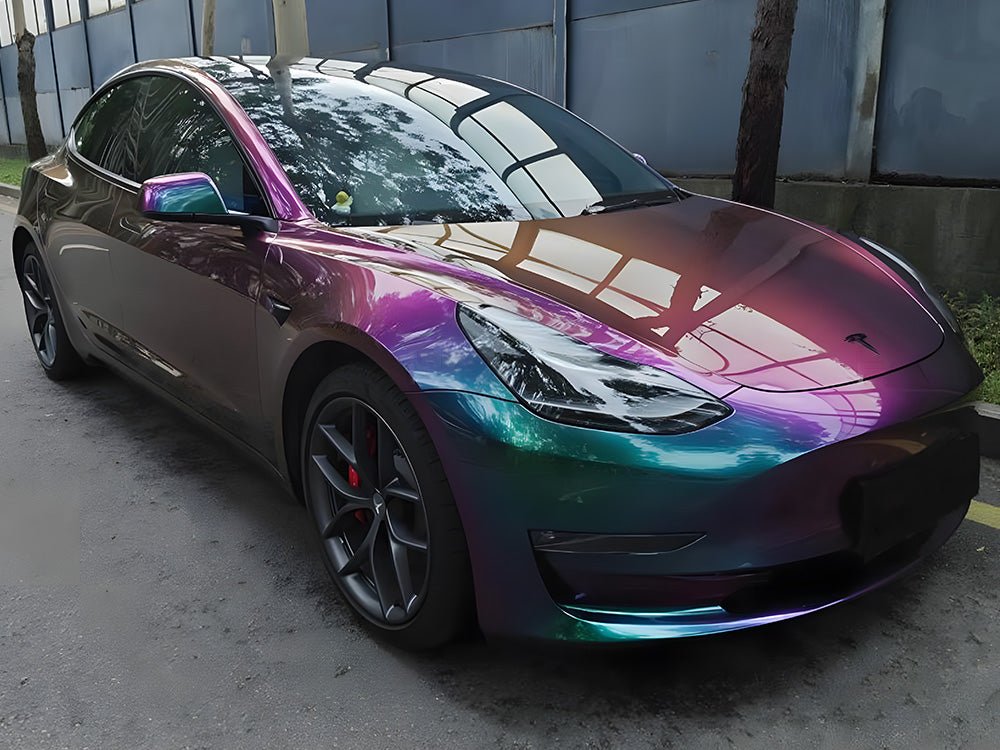
Color preference data from 11,700 invoices (Q1-Q3 2025) shows satin metallic grey (21 %), iridescent blue-green (15 %) and matte black (12 %) as the top three choices—evidence that buyers want OEM-plus finishes rather than lurid “Fast & Furious” hues.
9. The Counter-Arguments: Where TPU Still Needs Work
- DIY barrier – TPU is still too thick for amateur knife-less tape; mis-cut panels cannot be re-stretched like PVC.
- Raw-material volatility – isocyanate and BDO feedstock prices spiked 18 % in Q3 2025 after Middle-East turnarounds; margins could compress if oil repeats 2022 highs.
- Sensor occlusion – early matte-black TPU attenuated radar by 7 %; latest “AD-Safe” lacquer keeps it below 2 % but adds $80/roll.
None of these issues are deal-breakers, but they remind us that the road to mainstream is a marathon, not a sprint.
10.2026–2028 Outlook: What Has to Happen Next
- Sub-$700 roll cost – achievable if Chinese extrusion over-capacity persists and new bio-TPU routes (Cargill/COIM joint venture) scale.
- Robotic cut-and-apply cells – start-ups in Suzhou and Munich are beta-testing 6-axis arms that lay a hood panel in 90 seconds; success would eliminate installer bottleneck.
- OEM standardization – expect at least five global nameplates to follow NIO and list TPU wrap as a port-installed option by 2027, normalizing residual-value calculations for leasing companies.
- Second-life recycling loop – reverse-logistics pilots collecting peeled film, shredding and re-extruding into non-critical sheets (side steps, door kick plates) would close the sustainability narrative.
How to Choose the Right Gear for Any Season
Spring: Focus on layering and water-resistance
Summer: Prioritize breathability and sun protection
Autumn: Master layering and increase visibility
Winter: Protect extremities and invest in thermal gear
Conclusion
Fashion will always rotate: today satin grey, tomorrow metallic lavender. What is structurally different in 2025 is that consumers no longer accept either/or—they want beauty + armor + warranty + eco credentials in one roll. TPU color-change paint-protection film is the first category that delivers all four without a heart-stopping invoice. When OEMs, regulators, installers and finance companies line up on the same side of the table, the only remaining question is how fast the factories can spin the resin. Bet on TPU; the rest is just pigment.

The Author : CARLIKEWRAP
ARLIKE® launched in 2012, mainly focus on premium car wrapping vinyls, with rich colors and stylish designs. High performance with economic price is always the persuit of CARLIKE®.
Questions
What key material advantages does TPU color-change film offer over traditional PVC wraps, and how do these benefits influence consumer purchasing decisions?
Answer
How has the 25–30 % price drop in TPU rolls since 2023 changed the cost gap between protective color wraps and premium PVC-only films?
Answer
Why are OEMs such as NIO, BYD, and Hyundai integrating factory-installed TPU color wraps, and what impact does this have on market acceptance?
Answer
Which consumer segments drive the strongest demand for TPU color-change PPF, and what primary motivations does each segment cite?
Answer